Homeowner guide · Solar
Paying for Solar Panels With a HELOC: Options Compared
A HELOC can fund solar at the cash price with no dealer fee, but your home secures it and the rate can change. Compare it with cash, solar loans, leases and PPAs first.
Solar panels can lower your electric bills for decades, but how you pay for them often decides whether the math works. In 2026 the decision changed: the federal Residential Clean Energy Credit no longer applies to systems homeowners own that were placed in service after 2025. This guide compares the main ways to pay, shows a worked example and lists the questions to ask before you sign anything.
Key takeaways
- The IRS says the 25D credit is not available for property placed in service after December 31, 2025; check current IRS guidance for your situation.
- A HELOC lets you pay the installer’s cash price, avoiding solar-loan dealer fees, but it uses your home as collateral and usually has a variable rate.
- Solar loans can hide dealer fees of 10 to 30 percent or more of the cash price, according to the CFPB.
- Leases and PPAs need no upfront money but you do not own the panels; read escalators and transfer terms.
- Get three quotes with the cash price, and check your roof before you add panels.
Can you use a HELOC to pay for solar panels?
Yes. A home equity line of credit can pay an installer’s cash price directly. You borrow against your home, draw what you need and repay over time, usually at a variable rate.
A HELOC is a revolving line secured by your home (CFPB). Because the lender approves you, not the installer, you can shop the panels and the money separately. That is the main advantage: you negotiate the cash price, then fund it with the lowest-cost money available to you. For a full primer, see our plain-English guide to home equity lines.
- Equity: lenders commonly want you to keep some equity untouched after the line; requirements vary by lender.
- Variable rate: most HELOCs track the prime rate, so payments can rise or fall.
- Draw and repayment periods: many lines allow interest-only payments during a draw period, followed by principal and interest.
- Right to cancel: for a HELOC on your primary home, you generally have three business days after closing to rescind.
- Your home is collateral: missing payments can put the home at risk, so size the line to a payment you can carry.
Is there still a federal tax credit for home solar in 2026?
Not for homeowner-owned systems placed in service after December 31, 2025, according to the IRS. Unused credit from earlier years may carry forward. Check current IRS guidance before relying on any credit.
The Residential Clean Energy Credit (Section 25D) paid 30% of qualified costs for years, and many sales pitches still quote it. The One Big Beautiful Bill Act, signed in July 2025, ended it early. The IRS now states that the credit is not available for property placed in service after December 31, 2025, and that excess unused credit can be carried forward to reduce tax in future years (IRS). Systems finished in 2025 are claimed on Form 5695 with the 2025 return (IRS Form 5695).
If a salesperson mentions a 30% credit
Ask them to show it in writing with the IRS rule it relies on. For a system you own that is installed in 2026, the federal credit described on the IRS page no longer applies. Tax rules can change, so check current IRS guidance and talk with a tax professional.
State, local and utility incentives still exist in some places. The state incentive database run by the NC Clean Energy Technology Center lists them by state (DSIRE).
Free · no obligation · Solar
Get matched with solar pros near you
Secure & privateNo costNo obligationConsent on the next screen
HELOC vs solar loan vs lease vs PPA: which is cheapest?
Cash is usually cheapest overall, then low-cost secured borrowing like a HELOC. Solar loans can carry hidden dealer fees, and leases and PPAs trade ownership for no upfront cost.
| Option | You own panels? | Upfront cost | Key risks |
|---|---|---|---|
| Cash | Yes | Full price | Ties up savings |
| HELOC | Yes | None beyond closing costs | Variable rate; home is collateral |
| Home equity loan | Yes | Closing costs | Fixed payment; home is collateral |
| Cash-out refinance | Yes | Refinance closing costs | Resets your whole mortgage rate and term |
| Solar loan (installer-arranged) | Yes | Often none | Dealer fees hidden in principal; fixture filing on the home |
| Lease | No | Often none | Monthly escalators; transfer needed when you sell |
| Power purchase agreement (PPA) | No | Often none | Price per kWh may escalate; transfer at sale |
| PACE | Yes | None | Tax-bill lien; can complicate sale or refinance |
The CFPB found that some solar lenders charge hidden dealer fees that typically range from 10 to 30 percent of the cash price and can exceed 50 percent, which means a low advertised rate can cost more than a higher-rate loan without fees (CFPB). PACE financing is now subject to federal ability-to-repay rules that took effect March 1, 2026 (CFPB PACE rule).
What does a HELOC-funded solar system cost per month?
Illustrative: $24,000 at 8% costs about $160 a month interest-only, or about $291 a month to repay over 10 years. The same system through a 3.99% solar loan with a 25% dealer fee runs about $182 a month for 20 years.
| HELOC, repaid over 10 years | Solar loan with 25% dealer fee | |
|---|---|---|
| Cash price | $24,000 | $24,000 |
| Amount borrowed | $24,000 | $30,000 |
| Rate | 8% variable (assumed constant) | 3.99% fixed |
| Term | 10 years | 20 years |
| Monthly payment | About $291 | About $182 |
| Total paid | About $34,900 | About $43,600 |
The solar loan has the lower payment and the lower advertised rate, yet costs about $8,700 more in total because of the fee and longer term. The HELOC rate could rise, so test a higher-rate scenario too. If you itemize, HELOC interest may be deductible when the money is used to substantially improve the home that secures it; see IRS Publication 936 and ask a tax professional. To see how a new payment affects your budget, run the numbers in our DTI calculator for a new solar payment.
What should you check before signing a solar contract?
Get three quotes with the cash price, confirm roof age, check your utility’s net metering rules, read escalators and transfer terms, and know your three-day right to cancel in-home sales.
- Roof: if it needs replacing within about 10 years, replace it first. Panels must come off for a reroof, and that costs money. Our home improvement financing comparison covers paying for a new roof.
- Utility rules: net metering and export rates vary widely by state and utility and have changed in several states. Ask how the proposal assumed credits for exported power.
- Production estimate: ask for the modeled annual kWh and the assumptions. The U.S. Department of Energy’s homeowner solar guide lists questions to ask.
- Contract terms: warranties on panels, inverters and workmanship; who handles permits and interconnection; what happens if the company goes out of business.
- Cancellation: home sales of $25 or more generally carry a three-business-day right to cancel under the FTC Cooling-Off Rule (FTC).
- Selling later: owned panels transfer with the house; leases and PPAs need the buyer to qualify or a buyout.
The FTC also warns about high-pressure pitches, “free solar” claims and companies that promise savings they cannot show (FTC).
How do you get matched with a solar installer?
Request help below with your ZIP and whether you own the home. Installers serving your area can contact you with designs and cash-price quotes you can fund however you choose.
Before you request quotes, gather 12 months of electric bills, note your roof’s age and any shading, and decide how much of a monthly payment you are comfortable with. Installers can design more accurately with real usage, and you will be able to compare proposals on the same footing: cash price, expected production, warranty terms and the total cost under each way to pay. If a quote only shows a monthly payment, ask for the cash price before you go further.
You will confirm your phone with a one-time code, and only solar companies that serve your ZIP will reach out. Ask each for the cash price first. If you plan to use home equity, you can compare lenders separately; a side-by-side of HELOCs, home equity loans and reverse mortgages helps older homeowners weigh the choices.
Frequently asked questions
Is solar financed with a HELOC tax deductible?
HELOC interest may be deductible if you itemize and use the money to buy, build or substantially improve the home that secures the loan. See IRS Publication 936 and a tax professional.
Can I still claim the 30% solar tax credit?
Not for a system you own that is placed in service after December 31, 2025, per the IRS. Unused credit from earlier years may carry forward. Check current IRS guidance.
Is a HELOC better than a solar loan?
Often cheaper in total because you pay the cash price with no dealer fee, but the rate can vary and your home secures it. Compare total cost, not just the rate.
Do solar panels make it harder to sell my home?
Owned panels usually transfer simply. Leased panels and PPAs need the buyer to take over the contract or a buyout, which can slow a sale.
What is a dealer fee?
A charge some solar lenders add to the loan principal to offer a lower rate. Ask the installer for the cash price and compare it with the amount financed.
Should I install solar before replacing my roof?
If the roof has less than about 10 years of life left, most homeowners replace it first to avoid paying to remove and reinstall the panels.
Want to know how much equity you can tap? check what a home equity line could fund for panels before you request solar quotes.
Related on Mortgages+
More homeowner guides
 How to Pay for a New Roof, HVAC or RemodelWays to finance home improvements: a HELOC, a home equity loan, a cash-out refinance, an FHA 203(k) or other renovation loan, a personal loan or contractor financing.
 Should You Pay Off Your Mortgage Before You Retire?Paying off a mortgage before retiring makes sense when the rate is high and savings are ample. Investing often wins on low-rate loans if you keep cash and watch taxes.
 Estate Planning for Homeowners: Wills, Trusts and Your HouseYour home passes by its title: a will sends it through probate, a living trust or TOD deed can skip probate, and Medicaid or a reverse mortgage can shrink what heirs get.
 Paying for Senior Living With Home Equity: 5 OptionsYou can fund senior living or home care from your house by selling it, renting it, borrowing with a HELOC or bridge loan, or staying put with a reverse mortgage.
Run a solar business? Bid on solar leads from homeowners like these in the Mortgages+ partner marketplace.
Sources
Content reviewed November 18, 2026 against these authoritative sources.
- 1.IRS: Residential Clean Energy Credit
- 2.IRS: About Form 5695, Residential Energy Credits
- 3.IRS: Publication 936: Home Mortgage Interest Deduction
- 4.CFPB: What is a home equity line of credit (HELOC)?
- 5.CFPB: Issue Spotlight: Solar Financing (2024)
- 6.FTC: Solar Power for Your Home
- 7.U.S. Department of Energy: Homeowner’s Guide to Going Solar
- 8.DSIRE: Database of State Incentives for Renewables & Efficiency
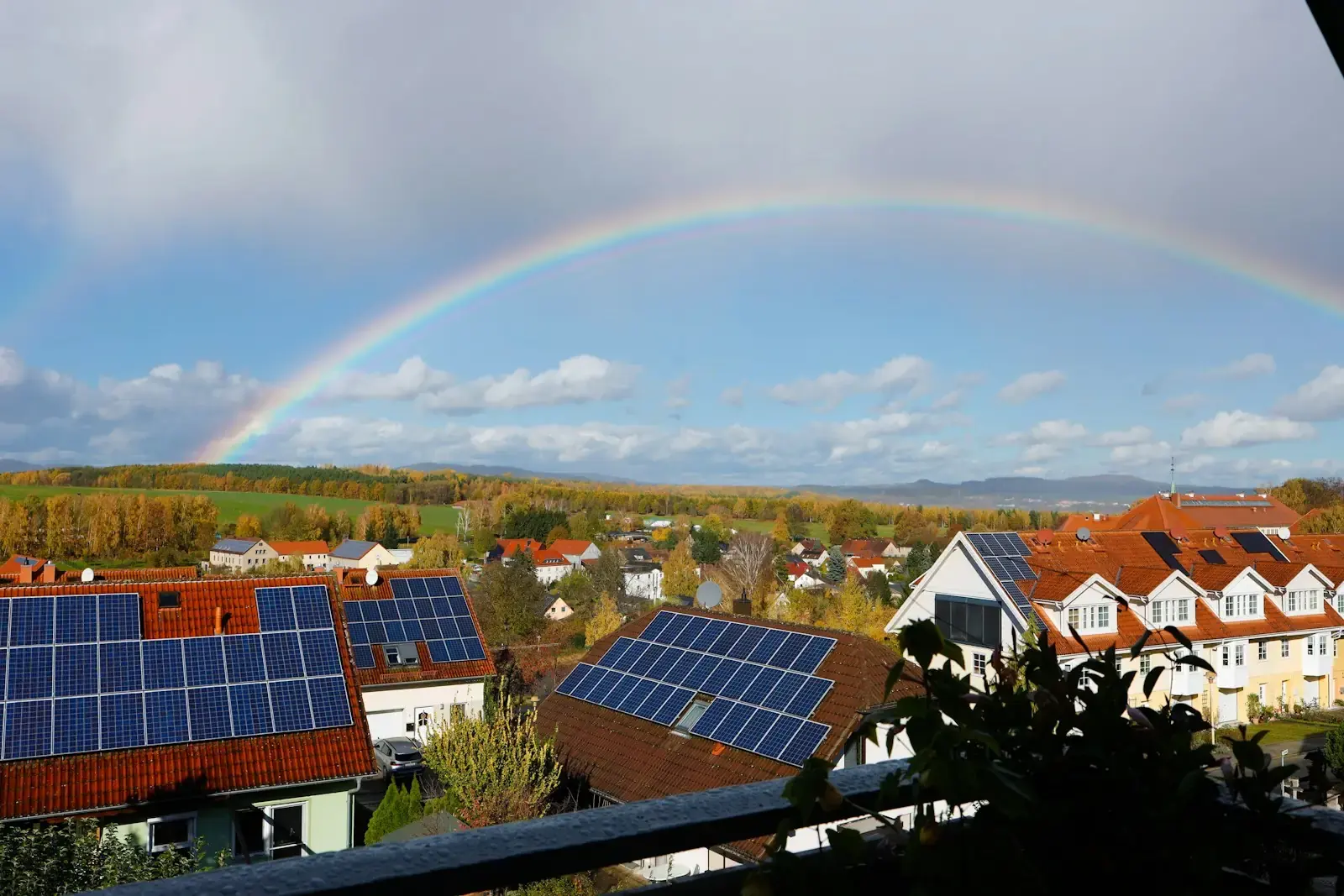
Photo: A rainbow over homes with rooftop solar by Lara John on Unsplash (Unsplash License).
Mortgages+ is a marketing platform, not a lender, insurer or service provider. When you request help, we match your request with one participating solar provider serving your ZIP code, who pays Mortgages+ for it. Mortgages+ may receive compensation from some companies featured on this site.
Ready when you are
Tell us a little about your home and we’ll match you with vetted help nearby.
Get matched →